Hello Flester, am I correct in assuming your from the general area of "The Banks" or do you just visit ? Fota I mean, not Spike Island. !!
OK, picks are essential if you wish to get a 'Solid Tone' (Dunlop 0.0225" would be ideal), pick-up placement is essential if you wish to obtain (perceived) sustain.
String gauge is essential to avoid tuning problems with bar pressure, and the type of bar for lap steel is a round-nose or Bullet bar as Tony said.(Essential to execute 'Split Slants'.)
Other than deep south open string blues, the heaviest gauge your guitar will take with comfort is what you should aim for.
Pickup height should optimally be about a smidgeon less than the thickness of a £1 coin. Any further and the sound could be a little hollow, any nearer and the magnetic pull will affect the tone and create "Wolf" notes.. (Not Wolf Tones, that's a different undesirable sound)
Many Many years ago Gibson, Rickenbacher and others found that placing the pick-up as near the bridge as possible reduced the transient to sustain ratio, not very important if you're going to play on your own, but TOTALLY essential if in a combo or using backing trax etc. Why, is a deep discussion and I WILL get into it elsewhere on the BSS Site later on. Trust me I do know a little about pick-ups...
Nice piece of wood, should have tons of sustain, and I like the narrow radius of the bridge, helps prevent string 'Whining' (usually caused by radii of more than 1/4") Pedal steels are prone to that problem as the changer fingers usually have an axle of that size and a radius of nearer 3/4".
Two and a half turns 'round the capstan on the tuners is optimum and after the first turn at it's uppermost point, you should direct the string the other side of the hole for the rest of the turns.
The shape at the top of the shaft is concave, the same as a ship's capstan, and achieves the same purpose. (As the string tightens it locks in on itself this way..)
Worm gear, tuner buttons and capstan are the correct terminologies for the component parts of the 'tuners': 'though many nowadays use shaft, which is incorrect as a shaft has essentially straight sides.
A resistor in the vol/tone circuit is used to 'bleed' the high frequencies as the pot is turned down.
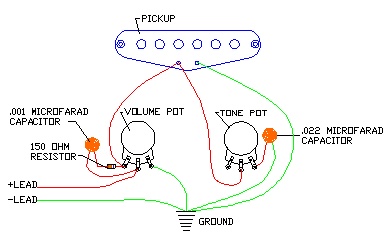
Many examples
HEREMore to come later.. If you wish..
BTW if you ARE from Contae Chorcaí, you may know of me as Basil Hendricks.. Sin é mo ainm.



 of Fenders, old Gibbos etc and see roughly where the p/up goes in relation to the bridge. That will help the sound.
  I just use that brand as a descriptor as Mr. Google can easily bring up the dimensions for reference [that's not a recommendation
  for Google, I just use that as a descriptor for search engines ....]


